Date Range Picker Element
The Date Range Picker Element allows the user to specify a Start date and an End date from a calendar-based interface:
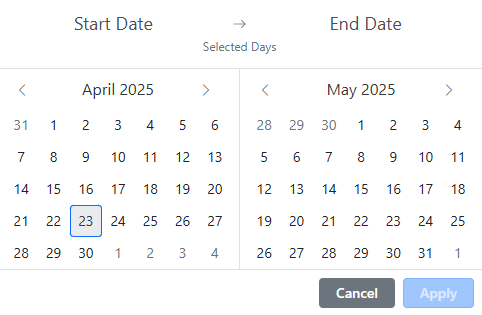
At runtime, to enter Start and End dates or change the existing dates, the user can click or tap the Calender button,  , at the right-hand end of the Element to display a calendar dialog (which shows separate Start Date and End Date calendars, as illustrated above) allowing them to locate and select the desired dates.
At the top of the dialog, you will see the current month and year displayed within the left-hand calendar, with '<' and '>' arrows on either side of the month and year. Clicking on these arrows will move backwards or forwards one month at a time. Within the right-hand calendar, the following month will be displayed. Below these two calendars are displayed the days of the Start date month and the days of the End date month, allowing the user to click on the required dates. By default, the current day will be selected within the Start Date calendar. To move more quickly, click on the month/year at the top of either calendar to display the months for the whole year instead of the days of the month. Now the current year will be displayed at the top of the dialog and the '<' and '>' arrows will move you backwards and forwards one year at a time. Click on the year at the top of either calendar to display 12 years beneath it, then use the arrows to move backwards and forwards 12 years at a time. At each level, making a selection will move the dialog back one level.
- Selecting an invalid date, such as a End date that is earlier than the Start date, will mean that the Apply button at the bottom of the dialog box will be unavailable. The Apply button will only be available when valid date ranges are used.
Alternatively, if allowed (see Manual Entry property below), a user can type-in the date, in any of the following formats and Digitise Forms will convert it to the date format specified in the Element's Date Format property (see below):
|
Format |
Examples |
|---|---|
|
yyyy-mm-dd, yyyy/mm/dd |
months and days can have optional leading zero 2018-1-3, 1964/01/03 |
|
yy-mm-dd, yy/mm/dd |
months and days can have optional leading zero 18-1-3, 18/01/03 years will be prefixed with '20' so 88/01/03 represents 3rd January 2088 |
| dd-mm-yyyy, dd/mm/yyyy |
months and days can have optional leading zero 3-1-2018, 03/01/1964 |
| dd-mm-yy, dd/mm/yy |
months and days can have optional leading zero 3-1-18, 03/01/18 years will be prefixed with '20' so 03/01/88 represents 3rd January 2088 |
When inputting a date read-in from a Datasource, the date must be read from a DateTime field.
When outputting a date, the date will be output to the Datasource in the format specified in the Date Format property (see below).

Once you have placed a Date Range Picker Element on a page, you can edit the Element's properties to configure the Element for your requirements. Select the Element on the page to display its properties in the Properties Pane. The following properties are available:
Element Version
The Element's version number, which may be (and is often) different to the installed version of the Digitise Forms software. For example, the version of the Element might be 1.5, but the version of the in-use/installed Digitise Forms software might be 2.0 etc.
Label
Allows you to change the text displayed in the label for this Element. You can change the default label to provide a more meaningful description or option for your users.

The properties in this category allow you to change the appearance of the Element.
Visible and Disabled Properties
Placeholder
Allows you to specify text which will be displayed within the edit box, for example to indicate that the user should enter a date or to specify the date format to be used for manual entry.
Separator
Allows you to specify the text to display between the two date strings within the text box. Set to '-' by default.
Date Format
Allows you to specify the format in which you want the dates to be displayed. The format specified here will also be used to output the contents of this field if an output mapping is specified.
Full Screen Mode
Allows you to set the Date Range Picker Calendar dialog to occupy the full screen on a mobile device.
Manual Entry
Allows you to specify whether users can type-in dates as well as use the Calender button to select them. If selected, users can type into the edit box or use the calender button. If deselected, the edit box will become read-only and users must use the calender button to select the required date.

The properties in this section allow you to specify validation criteria for the Element.

Start Date Value
Contains the current Start Date Value of this Element.
End Date Value
Contains the current End Date Value of this Element.
Minimum Date
Specifies the earliest date a user can enter. You can specify an input mapping to read the value in from a Datasource or manually enter a fixed (static) date. If you are specifying a static value, you can enter the required date using any of the formats listed in the table above. Leave blank if you don't want to provide a lower limit.
Maximum Date
Specifies the latest date a user can enter. You can specify an input mapping to read the value in from a Datasource or manually enter a fixed (static) date. If you are specifying a static value, you can enter the required date using any of the formats listed in the table above. Leave blank if you don't want to provide an upper limit.
For more information about mapping properties to data items in a Datasource see Data Tab Properties.


Behaviour Category
Minimum Days
The minimum number of days the user can select, after and including the selected date.
Maximum Days
The maximum number of days the user can select, after and including the selected date.
Allow Weekends
Allows the user to include weekends within the range selection. If you don't want to allow weekends to be entered, deselect this option.
Allow Past Dates
Allows the user to enter dates which are in the past. If you don't want to allow past dates to be entered, deselect this option.
Allow Future Dates
Allows the user to enter dates which are in the future. If you don't want to allow future dates to be entered, deselect this option.
Data Category
Default Time
Allows you to specify a time to be appended to the date entered into this Element. You can choose between midnight, 00:00:00, Current Time (UTC) or Current Time (Local Client Time). Current Time (UTC) will append the current UTC time - UTC stands for Coordinated Universal Time or, what was previously called Greenwich Mean Time, and Current Time (Local Client Time) will append the actual local time from the user's machine at the time of the selection. Note that the time is not displayed on the form but is included with the date when the value is written out to a database.
Styles Category
Label, Date Range Picker, and Error Message
Allow you to assign a style to the label, date display, calendar display button and invalid data error message text, respectively, e.g., to set the font type, size, and colour.